
AI & Digital Marketing: What Changes, What Stays Human
Digital marketing has always been evolving.
Search algorithms change. Consumer behavior changes. Platforms change. Advertising becomes more sophisticated.
But artificial intelligence is changing something deeper:
how marketers think, create, analyze, and make decisions.
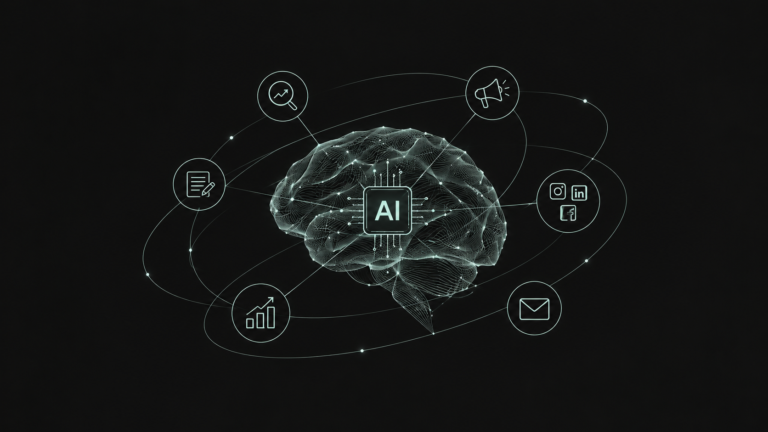
AI can now help generate content, analyze large amounts of data, identify patterns, personalize customer experiences, support SEO research, assist with advertising, and automate repetitive marketing tasks.
But the biggest opportunity isn’t simply doing marketing faster.
It’s using AI to make better marketing decisions.
That distinction matters.
AI Isn't Just Another Marketing Tool
For years, marketers worked with a familiar process:
Research → Plan → Create → Launch → Analyze → Optimize.
AI is increasingly becoming part of every stage.
It can help a marketer identify customer patterns before creating a campaign, generate variations of creative concepts, analyze campaign performance, summarize customer feedback, and identify opportunities that might otherwise take hours to uncover.
This doesn’t mean marketers can simply hand their work to AI.
It means the marketer’s role is evolving.
The competitive advantage is shifting from:
“Who can produce more content?”
to:
“Who can use technology to understand customers and make better decisions?”
1. AI Is Changing How Marketers Understand Customers
Good marketing begins with understanding people.
Who are they?
What do they need?
What influences their decisions?
What stops them from purchasing?
Traditionally, marketers have relied on surveys, analytics, social listening, customer interviews, campaign data, and market research to answer these questions.
AI can help marketers process and connect these different signals much faster.
For example, a marketer could analyze customer reviews, website behavior, campaign data, search queries, and social conversations to identify recurring themes.
The value isn’t simply the speed.
It’s the ability to spot patterns.
A campaign might have a high click-through rate but a low conversion rate.
Instead of looking only at the numbers, AI-assisted analysis can help marketers investigate where the customer journey is breaking down.
Data becomes more useful when it leads to a better question.
And that is where human judgment still matters.
2. Content Creation Is Moving From Production to Direction
AI has dramatically lowered the barrier to producing content.
A marketer can generate:
- Blog outlines
- Social media concepts
- Ad variations
- Email drafts
- Product descriptions
- Video scripts
- Headlines
- SEO content ideas
But this creates a new problem.
When everyone can create content quickly, content itself becomes less differentiated.
The advantage is no longer simply being able to produce 20 posts instead of five.
The advantage is knowing which five are worth producing.
This is where creative direction becomes more important.
A strong marketer needs to decide:
- What should the brand say?
- Why should the audience care?
- What emotional response should the content create?
- What makes this idea different?
- What should remain human?
- Where should AI assist rather than lead?
AI can accelerate production.
It shouldn’t replace the brand’s point of view.
3. AI Is Changing SEO and Search Strategy
Search is also evolving.
Traditional SEO focuses heavily on helping websites become visible in search results.
But users are increasingly interacting with search through conversational and AI-driven experiences.
That means marketers need to think beyond keywords.
They need to understand:
What questions are people asking?
What information are they looking for?
What makes a source trustworthy enough to be referenced?
This is creating greater importance around areas such as answer-focused content, topical authority, structured information, first-hand expertise, and useful content.
The goal is moving from simply:
“How do I rank for this keyword?”
toward:
“How do I become a useful and credible source for this topic?”
For businesses competing in markets such as Saudi Arabia, this also creates opportunities to develop content around local customer questions, Arabic and English search behavior, and location-specific intent.
4. Paid Advertising Is Becoming More Data-Driven
AI is also changing performance marketing.
Modern advertising platforms can already use machine learning to help with bidding, targeting, placements, creative combinations, and optimization.
But AI doesn’t eliminate the need for marketers.
It changes where marketers should spend their attention.
Instead of manually managing every small campaign adjustment, marketers can spend more time thinking about:
Audience strategy.
Offer positioning.
Creative concepts.
Customer psychology.
Landing-page experience.
Budget allocation.
Business objectives.
This is an important shift.
Automation can optimize what happens inside a campaign.
Strategy determines whether the campaign should exist in the first place.
5. Personalization Is Becoming More Powerful
Customers increasingly expect brands to understand their needs.
AI can help businesses deliver more personalized experiences by analyzing customer behavior and identifying patterns.
Imagine an e-commerce business that can adapt its recommendations based on what a customer has viewed, purchased, searched for, or interacted with.
Or an email campaign that changes its messaging based on customer behavior.
Or a website that provides different content depending on where a visitor is in the buying journey.
The objective isn’t personalization for the sake of personalization.
It’s relevance.
The right message becomes more powerful when it reaches the right person at the right moment.
6. Analytics Is Moving From Reporting to Decision-Making
One of the most interesting changes is happening in marketing analytics.
Historically, marketers often spent significant time answering:
What happened?
How many people visited the website?
How many clicked the ad?
What was the conversion rate?
What was the cost per acquisition?
These metrics remain important.
But the bigger question is:
Why did it happen, and what should we do next?
AI can help marketers analyze larger datasets, identify unusual changes, surface patterns, and summarize performance.
This can make reporting more useful.
Instead of presenting a dashboard filled with numbers, the marketer can focus on the story behind the numbers:
What changed?
Why might it have changed?
What should we test next?
That’s where analytics becomes strategy.
But There Is One Thing AI Cannot Replace
There is a temptation to think that AI will eventually handle everything.
Strategy.
Creativity.
Content.
Advertising.
Analytics.
But marketing isn’t only a technical process.
It is a human discipline.
People don’t buy simply because an algorithm identified them as the right audience.
They buy because something feels relevant.
They trust a brand.
They connect with a story.
They believe a product will improve their lives.
They feel understood.
AI can identify patterns in human behavior.
But marketers still need to understand the humans behind those patterns.
That is why creativity, empathy, cultural understanding, critical thinking, and strategic judgment remain valuable.
The Future Marketer Isn't “Human vs AI”
The more useful question isn’t:
“Will AI replace digital marketers?”
It’s:
“Which parts of marketing should AI handle, and which parts require human judgment?”
AI is excellent at helping with scale, speed, pattern recognition, research assistance, automation, and repetitive tasks.
Humans remain essential for positioning, emotional understanding, creative judgment, ethical decisions, cultural nuance, and strategic direction.
The strongest marketers will combine both.
AI for acceleration.
Human thinking for direction.
What Should Marketers Do Now?
You don’t need to become an AI engineer to stay relevant.
But you do need to become comfortable working alongside AI.
Start by identifying repetitive tasks in your marketing workflow.
Then ask:
Can AI make this faster?
Next ask a more important question:
Can AI help me make this better?
Use AI to explore ideas, analyze information, identify patterns, test variations, support research, and accelerate execution.
But don’t outsource your judgment.
Question the output.
Verify important information.
Protect brand voice.
Understand your audience.
And always connect the work back to a business objective.
Because the future of marketing isn’t about using AI everywhere.
It’s about knowing where AI creates value.
The Real Competitive Advantage
AI is making marketing faster.
But speed alone isn’t a competitive advantage anymore.
When everyone has access to powerful tools, the difference comes from how intelligently those tools are used.
The marketers who stand out won’t necessarily be the ones generating the most content or using the most AI tools.
They will be the ones who can connect:
Data → Insight → Strategy → Creativity → Action → Results.
That is the real transformation.
AI isn’t removing the need for marketers.
It is raising the standard for what a good marketer can do.